
17/09/2025

RocaSalvatella
For years, the main goal was clear: to be in Google's top 3. But in 2025, that goal is no longer enough.
With the arrival of AI Overviews, Google's search engine no longer shows you a list of links first. Now, in many searches, the user directly sees a summary generated by artificial intelligence with the information they need… without needing to click.
And that raises a strategic question for many brands:
Should we continue doing SEO or focus solely on appearing in those AI-generated answers?
The new scenario: does AI generate the answer in the first position?
Google officially introduced AI Overviews on 14 May 2024, as part of its SGE (Search Generative Experience) project in the US.
In Europe, after trials in March 2025, Google officially activated them on 25 March 2025 in nine European countries: Spain, Germany, Austria, Italy, Belgium, Ireland, Portugal, Poland and Switzerland, with a progressive expansion to the rest of the European countries before the end of 2025, once EU regulation is met.

These AI Overviews normally appear above organic results, ads and traditional links, although in recent months we have seen that Google is carrying out tests and we have even seen them in other parts of the search results page.
But they do not replace SEO: AI Overviews reflect well-executed traditional SEO.
Do you want to appear in AI Overviews? Do SEO.
AI Overviews do not generate original content. They select from the content that has already been created, reorganise it and present it. And to be selected, the sources must meet clear criteria: authority, structure and clarity.
A study by Ahrefs from May 2025 revealed that 76% of the pages cited in AI Overviews were already in Google's organic top 10. What this tells us is very simple: If you don't do SEO, you won't appear in either classic or AI-generated results.
Now, to be in AI Overviews you don't need to reinvent the wheel, you just need to refine your current SEO with more demanding criteria.
These are some practical keys to make your content eligible as a source for AI:
Schema Markup
Implement structured data (Article, FAQ, HowTo, Product, etc.). This allows engines to accurately understand the role and content of each page.
If you don't speak the language of AI, it won't understand you.Highlight the thesis of your content
The most relevant information, your main argument or the most valuable insight must appear in the first paragraphs so that the idea of what we are going to talk about is captured from the very beginning and there are no misunderstandes. AI prioritises what it finds first.Useful and well-structured content
Use hierarchical headings, lists, bullets, tables and short sections. This makes it easier for both the reader and the AI to scan and understand the content.Clear and accessible navigation
A clear navigation structure and well-distributed internal links help AI understand your thematic architecture and hierarchy of information. This is why it is also highly recommended to add a table of contents, especially on pages with a lot of information.Long-tail keywords
Searches that trigger AI Overviews tend to be more specific and conversational.
Optimising for long-tail keywords makes you more relevant for those complex and contextual queries that look for something very specific.Have others talk about you. You decide whether good or bad
AIs tend to cite sources that not only publish good content but are also mentioned by others in different contexts. The more external presence you have —on forums like Reddit or Quora, in media outlets or on pages like Wikipedia— the more authority language models perceive. These mentions, which you should keep in mind in your link-building strategy, reinforce your relevance and increase the likelihood of AI selecting you as a source.
The crocodile bite, the collateral damage.
One of the most talked-about side effects after the rollout of AI Overviews is what Roberto García defined on LinkedIn as the “crocodile effect”:
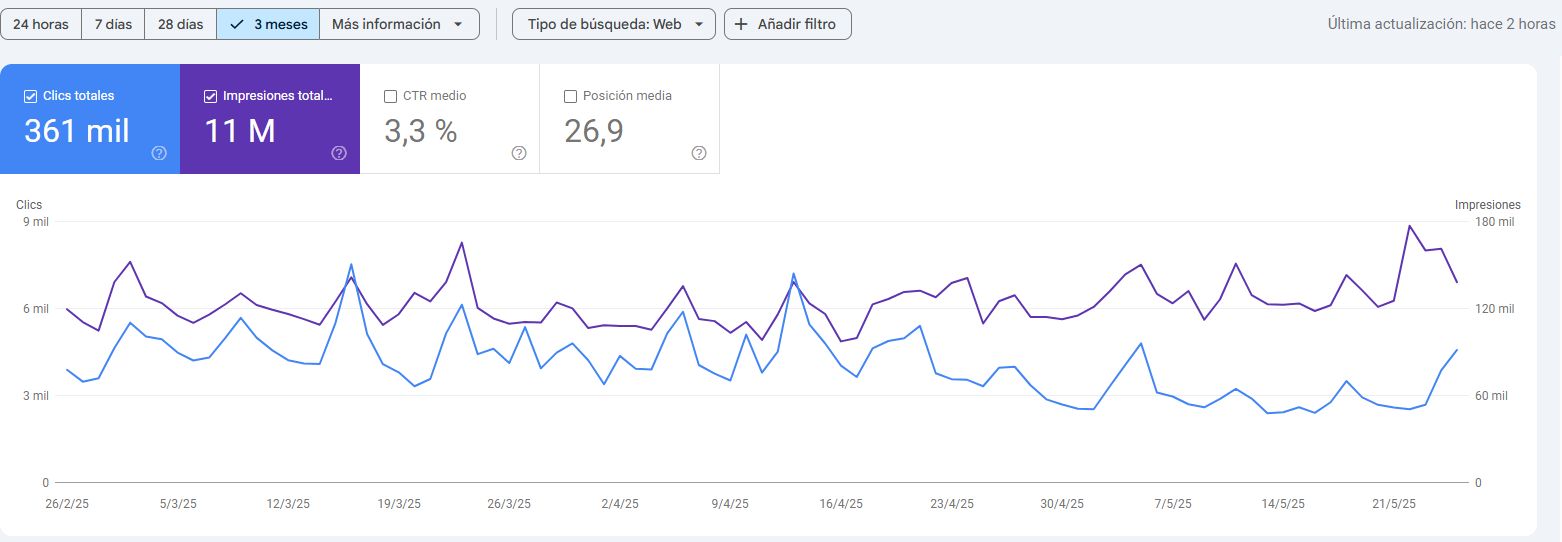
In Google Search Console, you start to see that impressions are growing (because you appear in the AI summary), but clicks are dropping (because the user no longer needs to click on any link), forming what looks like a crocodile's mouth with its teeth and everything.
This has two important implications:
Your results appear on Google, but the audience does not click because they stick with the result of the answer generated by Google.
Even so, SEO remains essential. In the short term, a lower number of clicks does not always imply a drop in revenue. However, if your business depends exclusively on traffic from purely informational websites and you feel that your income is at risk (because you lived off clicks to your website), it is crucial to adapt your strategy and not just wait to see what happens. You must look for new ways to showcase your content and not depend solely on Google. It is also time to re-evaluate how you measure conversions to adapt to this new scenario.
The rise of acronyms… and the return to essentials.
Over the last year, digital marketing has been filled with new acronyms to name every new trend:
LLMO – Large Language Model Optimization
GEO – Generative Engine Optimization
AEO – Answer Engine Optimization
AXO – AI Experience Optimization
APO – AI Prompt Optimization
AMO – AI Mention Optimization
ATRO – AI Trust & Retrieval Optimization
… and many more.
Necessary? Yes.
Confusing? Often.
Do they replace SEO? No.
It is the same thing that happens with local SEO: it has its own techniques, but it is still SEO. It only requires applying the principles of classic SEO to the context in front of us.
And that is precisely what happens with most of these new acronyms: You don't need 5 different strategies. You need 1 SEO strategy with vision, structure and adaptability.
And what about ChatGPT, Perplexity or Claude?
Although Google continues to dominate the market, we cannot ignore the rise of other LLMs. According to a study by First Page Sage conducted in July 2025:
Google maintains 81.6% of the global search share.
ChatGPT, although taking up only 9%, represents a significant share for a platform that has emerged recently.
The rest (Perplexity, Claude, Bing…) represent 7.4%.
Even so, user behavior is changing:
More and more people are consulting AI directly for summaries, ideas, complex answers or comparisons. And when they do, AI also selects optimised, structured and reliable content.
Conclusion: SEO for AI does not replace traditional SEO. It rewards it.
AI Overviews have changed the way Google presents information. But they have not changed what it values. Google's AI chooses what you should already be optimising: clarity, structure, value and authority.
So if you are wondering whether you should leave SEO behind to focus on these new technologies, remember:
There is no visibility in AI without SEO. And there is no conversion without strategy.
Your content must not only be well-positioned, it must be ready to be cited, read by machines, and valued by humans.
Because in 2025, doing SEO is not about filling Google. It is about being the source that AI chooses.